



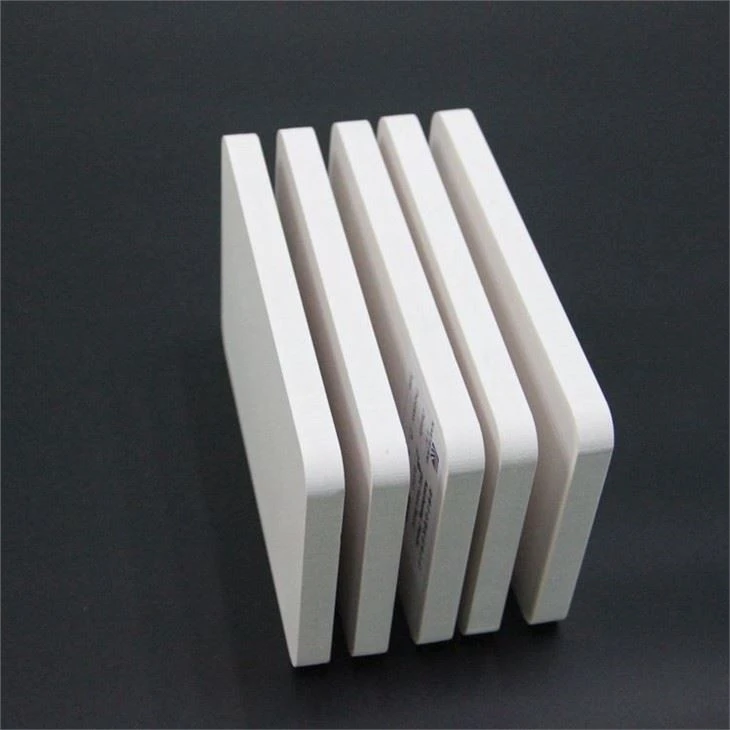
As a supplier of 18mm PVC Foam Board, I've been frequently asked about the specific heat capacity of this product. Specific heat capacity is a crucial physical property that determines how much heat energy a material can absorb or release for a given change in temperature. Understanding the specific heat capacity of 18mm PVC Foam Board can help our customers make informed decisions about its applications, especially in scenarios where thermal management is important.
What is Specific Heat Capacity?
Before delving into the specific heat capacity of 18mm PVC Foam Board, let's first clarify what specific heat capacity means. Specific heat capacity, denoted as (c), is defined as the amount of heat energy (Q) required to raise the temperature of a unit mass (m) of a substance by one degree Celsius (or one Kelvin). Mathematically, it can be expressed as (c=\frac{Q}{m\Delta T}), where (\Delta T) is the change in temperature. The SI unit of specific heat capacity is joules per kilogram per degree Celsius ((J/(kg\cdot^{\circ}C))).
Different materials have different specific heat capacities. For example, water has a relatively high specific heat capacity of about (4186 J/(kg\cdot^{\circ}C)), which means it can absorb a large amount of heat energy without a significant increase in temperature. This property makes water an excellent coolant in many industrial and domestic applications. On the other hand, metals generally have lower specific heat capacities, which is why they heat up and cool down quickly.
Specific Heat Capacity of 18mm PVC Foam Board
The specific heat capacity of 18mm PVC Foam Board depends on several factors, including the composition of the PVC material, the density of the foam, and the presence of any additives or fillers. PVC, or polyvinyl chloride, is a synthetic plastic polymer that is commonly used in a wide range of applications due to its excellent mechanical properties, chemical resistance, and affordability.
In general, the specific heat capacity of PVC ranges from approximately (900 J/(kg\cdot^{\circ}C)) to (1200 J/(kg\cdot^{\circ}C)). However, the foam structure of the 18mm PVC Foam Board can significantly affect its specific heat capacity. The air pockets within the foam act as insulators, reducing the overall thermal conductivity of the material and increasing its ability to store heat energy. As a result, the specific heat capacity of 18mm PVC Foam Board is typically higher than that of solid PVC.
Based on our testing and industry data, the specific heat capacity of our 18mm PVC Foam Board is around (1100 J/(kg\cdot^{\circ}C)) to (1300 J/(kg\cdot^{\circ}C)). This value may vary slightly depending on the specific formulation and manufacturing process of the product. It's important to note that these values are approximate and can be influenced by factors such as temperature, humidity, and the presence of impurities.
Importance of Specific Heat Capacity in Applications
The specific heat capacity of 18mm PVC Foam Board plays a crucial role in many of its applications. Here are some examples:
Thermal Insulation
One of the primary uses of 18mm PVC Foam Board is in thermal insulation applications. The high specific heat capacity of the foam board allows it to absorb and store heat energy, reducing the transfer of heat through the material. This property makes it an ideal choice for insulating buildings, refrigerators, and other structures where temperature control is important.
For example, in a building, the 18mm PVC Foam Board can be used as wall insulation to prevent heat from entering or leaving the building. During the hot summer months, the foam board absorbs the heat from the outside, keeping the interior cool. In the cold winter months, it retains the heat inside the building, reducing the need for heating.

Signage and Displays
18mm PVC Foam Board is also commonly used in signage and display applications. The specific heat capacity of the material can affect its performance in these applications, especially in outdoor environments where the temperature can vary significantly.
The high specific heat capacity of the foam board helps to stabilize its temperature, preventing warping and deformation due to thermal expansion or contraction. This ensures that the signage and displays maintain their shape and appearance over time, even in extreme weather conditions.
Packaging
In the packaging industry, 18mm PVC Foam Board can be used to protect delicate and sensitive products during transportation and storage. The specific heat capacity of the foam board helps to absorb and dissipate any heat generated during transit, preventing damage to the products.
For example, electronic devices such as computers and smartphones can generate a significant amount of heat during operation. By using 18mm PVC Foam Board as packaging material, the heat can be absorbed and distributed evenly, reducing the risk of overheating and damage to the devices.
Comparison with Other Materials
To better understand the specific heat capacity of 18mm PVC Foam Board, let's compare it with some other commonly used materials:
| Material | Specific Heat Capacity ((J/(kg\cdot^{\circ}C))) |
|---|---|
| Water | 4186 |
| Aluminum | 900 |
| Steel | 460 |
| Solid PVC | 900 - 1200 |
| 18mm PVC Foam Board | 1100 - 1300 |
As shown in the table, 18mm PVC Foam Board has a higher specific heat capacity than solid PVC and many metals. This makes it a better choice for applications where thermal insulation and heat storage are important.
Our 18mm PVC Foam Board Products
At our company, we offer a wide range of 18mm PVC Foam Board products to meet the diverse needs of our customers. Our products are made from high-quality PVC materials and are manufactured using advanced production techniques to ensure consistent quality and performance.
In addition to the standard 18mm PVC Foam Board, we also offer High Glossy PVC Co-extruded Foam Board, which has a smooth and shiny surface finish, making it ideal for high-end signage and display applications. We also have 6mm PVC Foam Sheet available for customers who require a thinner and more flexible option.
If you're interested in our PVC Foam Board 18mm products or have any questions about specific heat capacity or other technical aspects, please don't hesitate to contact us. Our team of experts is always ready to assist you and provide you with the information you need.
Conclusion
In conclusion, the specific heat capacity of 18mm PVC Foam Board is an important physical property that affects its performance in many applications. With a specific heat capacity of around (1100 J/(kg\cdot^{\circ}C)) to (1300 J/(kg\cdot^{\circ}C)), our 18mm PVC Foam Board offers excellent thermal insulation and heat storage capabilities, making it an ideal choice for a wide range of applications.
If you're looking for a high-quality 18mm PVC Foam Board with superior thermal properties, look no further. Contact us today to discuss your requirements and explore how our products can meet your needs. We're committed to providing our customers with the best products and services, and we look forward to working with you.
References
- "Polyvinyl Chloride (PVC) - Properties, Applications, and Recycling." Encyclopedia of Polymer Science and Technology. John Wiley & Sons, Inc., 2003.
- "Thermal Properties of Polymers." Polymer Handbook. John Wiley & Sons, Inc., 2009.
- Company internal testing data and research reports.