BUYING GUIDE · DENSITY · QUOTATION COMPARISON
Two quotations can both say "20mm white PVC board" and still describe different grades. Before comparing the price per sheet, establish what is being supplied: the actual thickness, overall density, sheet size, surface requirement and packing.
Our 20mm PVC Celuka Foam Board is one example: density starts at 0.45 g/cm³ for advertising uses, while cabinet customers commonly select 0.55, 0.60 or 0.65 g/cm³. Those choices change the amount of material in each sheet and the starting point for a fair price comparison.

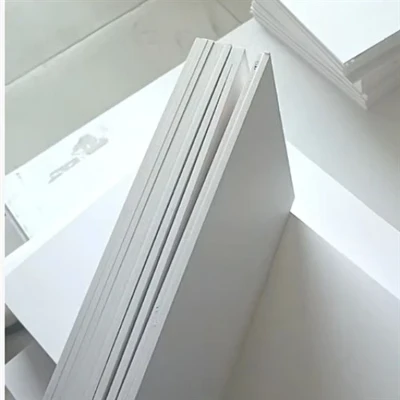
Celuka sheet surface and foamed core. Overall density describes the complete board.
1. Start with Material Weight, Not Thickness Alone
Thickness tells you the depth of the sheet. Overall density describes its mass relative to its complete volume, including both the Celuka skin and foamed core. Two sheets of the same dimensions can therefore have noticeably different weights.
| Overall Density | Calculated Net Weight per Sheet | Weight Relative to 0.45 Grade |
|---|---|---|
| 0.45 g/cm³ | 26.79 kg | 100% |
| 0.55 g/cm³ | 32.74 kg | 122.2% |
| 0.60 g/cm³ | 35.72 kg | 133.3% |
| 0.65 g/cm³ | 38.70 kg | 144.4% |
Calculated for nominal 1220 × 2440 × 20mm sheets. Figures are theoretical net material weights; actual weights depend on dimensions and density tolerances. Packing is excluded.
About 44% more material weight
At the same sheet dimensions, a 0.65 g/cm³ board weighs approximately 44.4% more than a 0.45 g/cm³ board. If both were quoted at the same price per kilogram, their prices per sheet would still differ by the same proportion. Actual supplier prices also depend on formulation and order requirements.
This is why a low sheet price needs a grade specification beside it. A lighter board can be a practical choice for lettering, while a cabinet component may call for a denser grade. Compare prices after identifying which grade suits the finished part.
2. Check Overall Density Using Net Weight
Ask whether the quoted density refers to the whole board or only a surface or core measurement. For purchasing standard sheets, net sheet weight offers a useful cross-check of the overall-density claim.
For a nominal 1220 × 2440 × 20mm sheet, the calculation is:
Overall density (g/cm³) = net sheet weight (kg) ÷ 59.536
For example, 35.72 kg ÷ 59.536 is approximately 0.60 g/cm³.
Remove packing weight and use the measured length, width and thickness when checking an actual sheet. If the sheet is thinner than the nominal 20mm, using the nominal volume will distort the density calculation. Weighing the sheet does not replace a thickness check.
3. Compare the Quotation Unit and Delivery Basis
A quotation per kilogram cannot be compared directly with one per sheet. Convert them to the same basis. For a weight-based quotation, the material amount per sheet follows the agreed net weight; a standard 1220 × 2440mm sheet also has an area of 2.9768 m².
Compare the same order quantity, color, surface finish and delivery basis. A price that includes a selected packing method or freight covers a different scope from a bare material price. Keep those items visible when reviewing offers.
4. Look at Cost per Usable Finished Part
For a sign maker, the useful result is a finished letter or logo. For a cabinet maker, it is an acceptable panel or component. Sheet price is only one part of that calculation.
Material cost per usable part = sheet price ÷ usable parts obtained from the sheet. Use the actual cutting layout and count accepted pieces. Nesting, narrow details, edge finishing and rejected parts can change that result.
Evaluate a representative design using the planned grade and process. Our CNC cutting information discusses the machining details relevant to letters and fabricated components.

Surface appearance alone does not establish overall density or sheet weight.
5. Put the Key Details Side by Side
| Quotation Item | What to Ask the Supplier | Why It Matters |
|---|---|---|
| Thickness | Actual thickness and agreed tolerance | Nominally identical sheets may differ in volume and finished-part fit. |
| Density / Sheet Weight | Overall board density and expected net sheet weight | Makes the material-weight basis of the offer clear. |
| Surface and Processing | Celuka structure, intended finish and machining requirements | Connects the grade to edge appearance and the finished component. |
| Price Unit | Per sheet, kilogram or square metre | Allows conversion to one comparison basis. |
| Packing | Included packing method and any combined protection | Clarifies what the price covers and how the boards will be handled. |
| Order / Delivery Basis | Same quantity, delivery terms and destination or port where relevant | Keeps freight and order-size differences visible. |
Density also affects shipment weight. A group of 100 nominal sheets at 0.65 g/cm³ contains about 1.19 tonnes more net material than 100 sheets at 0.45 g/cm³. Container planning must therefore consider both sheet volume and weight, together with the packing.
Choose the Grade Around the Application
For carved letters and dimensional logos, begin with the desired profile, detail and edge finish, then consider weight and budget. Kaichuang supplies the 20mm thickness from 0.45 g/cm³ for these advertising applications.
For cabinet and furniture components, 0.55, 0.60 and 0.65 g/cm³ are common choices. Within comparable formulations and production conditions, higher density generally improves hardness and screw holding. Hardware, joint design and the intended component still belong in the selection discussion.
Compare a Complete 20mm Board Specification
Send your application, sheet size, target density or net sheet weight, quantity and packing preference. We can help you put the quotation on a clear specification basis. The linked product page provides the available 20mm Celuka board options.
Celina | PVC Foam Board Export Sales
Zibo Kaichuang Plastic Co., Ltd.
Email: Celinayue@kaichuangplastic.com
WhatsApp: +86 18053328687